If you’ve spent any time researching garage floor coatings, you’ve probably run into two names over and over: epoxy and polyaspartic. Both show up in nearly every conversation about concrete coatings, and both get marketed as “the best” depending on who’s selling them. The truth is more specific than that. Which one makes sense for your garage depends on your timeline, your budget, how the space gets used, and even the season you’re coating it in.
I’m Dante Horton, founder of Kickback Coatings. I’ve installed both systems across garages, patios, and commercial spaces throughout Round Rock, Georgetown, Cedar Park, and the surrounding Austin area, and I’ve seen where each one performs well and where it doesn’t. This isn’t a sales pitch for one product over the other — it’s a breakdown of how they actually differ, so you can make a decision based on your situation instead of whichever product a salesperson happens to be pushing that week.
What Sets Epoxy and Polyaspartic Apart Chemically
Epoxy coatings cure through a chemical reaction between a resin and a hardener. That reaction takes time — typically 12 to 24 hours between coats, and several days before the floor is ready for heavy use. This slower cure is actually part of what makes epoxy strong. It allows the material to fully bond to the concrete and build a thick, dense layer that resists abrasion well.
Polyaspartic coatings are a type of polyurea and cure much faster, often within a couple of hours per coat. That speed comes from a different chemical structure, and it changes almost everything about the installation process — from how many coats can go down in a single day to how the material handles temperature and humidity during application. Polyaspartic topcoats are also more UV-stable than standard epoxy, meaning they’re less likely to yellow or fade if exposed to sunlight over the years, which matters more on patios and breezeways than in an enclosed garage.
Installation Timeline: Days vs. Hours
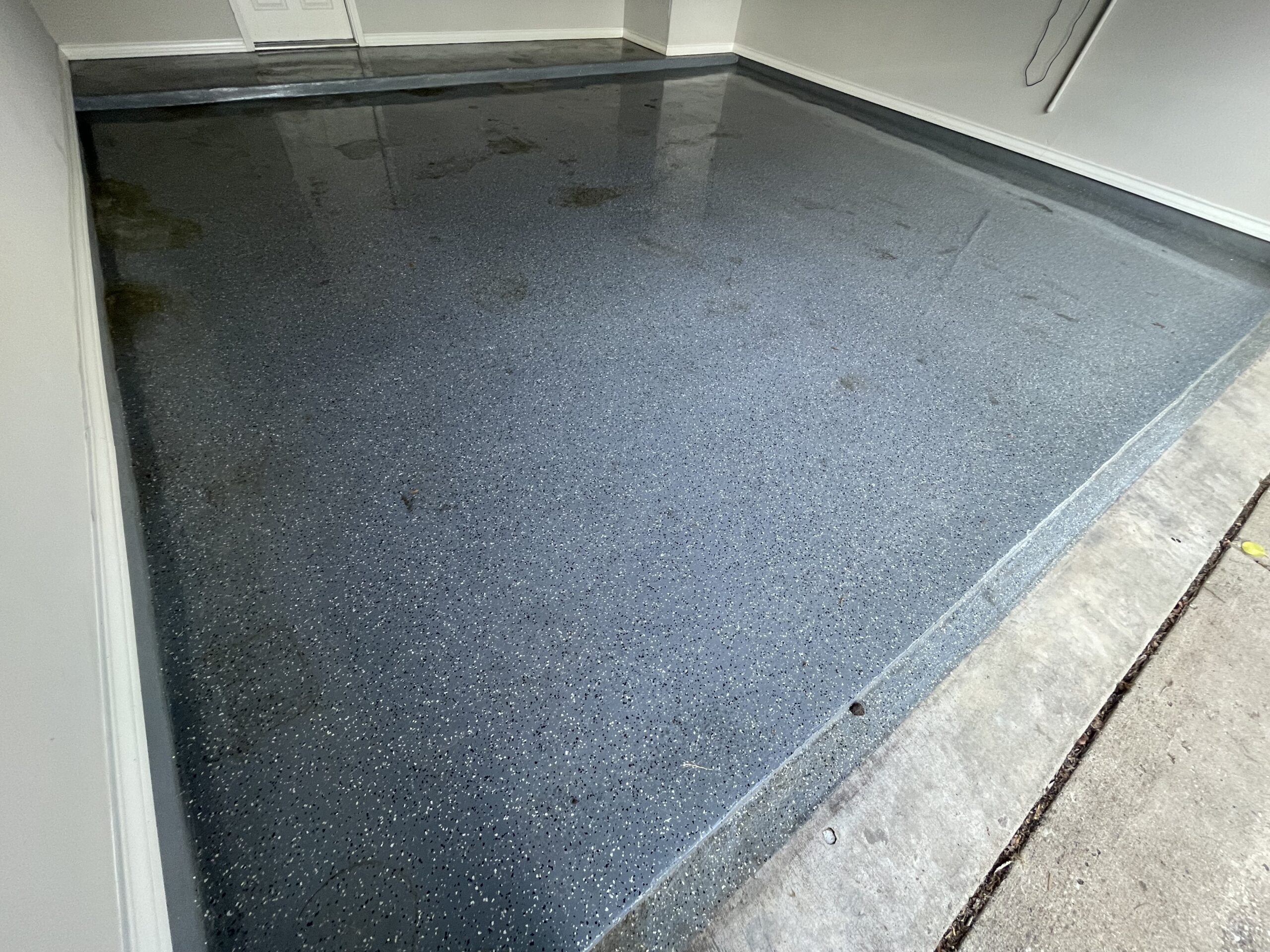
This is usually the deciding factor for homeowners with one garage bay and no alternative parking. A full epoxy floor coating system, including concrete surface preparation, base coat, decorative flake if desired, and a protective topcoat, generally takes two to three days from start to finish, with the floor needing additional curing time before vehicles can drive on it again.
A polyaspartic system can often be completed start to finish in a single day, and the garage can typically be walked on within hours and used for light vehicle traffic much sooner than with epoxy. If you’re coating a commercial facility that can’t afford to shut down operations for multiple days, or a residential garage that’s your only parking option, this difference alone often settles the decision.
Durability and Long-Term Performance
Both systems are significantly more durable than bare or sealed concrete, but they hold up differently under specific conditions.
Epoxy is a thicker, harder material, which makes it well suited to heavy static loads — think tool chests, work benches, or long-term storage. Where epoxy tends to struggle is with hot tire pickup, a phenomenon where warm tires (especially after highway driving) can slightly lift or mark the coating as they cool and contract on the surface.
Polyaspartic coatings are generally more flexible and more resistant to hot tire pickup, along with better resistance to UV exposure and temperature swings. That flexibility also makes them somewhat more forgiving of minor concrete movement over time, which is relevant in Central Texas, where our clay-heavy soil causes more seasonal concrete shifting than sandier soil types in other parts of the state.
Neither system is “more durable” across the board. It depends on what the floor needs to withstand.
Cost Considerations Beyond the Sticker Price
Polyaspartic coatings typically carry a higher material cost per square foot than standard epoxy. However, because installation takes far less time, labor costs can be lower, and some of that gap narrows once you look at total project cost rather than just materials.
Epoxy systems, particularly full flake epoxy systems or metallic epoxy flooring, often make more financial sense for larger commercial spaces like warehouses or showrooms, where the extended cure time is less disruptive and the lower material cost per square foot adds up meaningfully across thousands of square feet.
For a typical two-car residential garage, the total cost difference between a quality epoxy system and a polyaspartic system is often smaller than people expect, especially once you factor in proper concrete surface preparation, which should never be skipped regardless of which topcoat you choose.
Why Surface Preparation Matters More Than the Coating You Pick
I’ll say this to every customer regardless of which system they choose: the coating is only as good as the surface underneath it. Diamond grinding, moisture testing, and addressing any concrete crack repair or joint repair before installation are what determine whether a coating bonds properly and lasts for years instead of peeling within a season.
I’ve seen plenty of garages where a homeowner paid a premium for polyaspartic material, but the contractor skipped proper grinding or didn’t test for moisture vapor issues, and the coating failed within a year. I’ve also seen standard epoxy systems that have held up beautifully for five-plus years because the prep work was done correctly. The topcoat gets the attention, but the surface preparation is where a floor’s lifespan is actually decided.
Which One Should You Choose?
There isn’t a universal right answer, but here’s a general framework based on what I evaluate on every job:
- Choose polyaspartic if you need the garage or space usable again within a day, you’re in a climate with wide temperature swings, or hot tire pickup resistance is a priority.
- Choose epoxy if you’re working with a larger commercial space where cost per square foot matters more than turnaround time, or if you want a thicker, highly customizable system with decorative flake or metallic finishing options.
- Combine both — many of the strongest systems I install actually use an epoxy base coat for adhesion and build, topped with a polyaspartic topcoat for speed, UV stability, and chemical resistance. This hybrid approach often delivers the best of both systems.
Conclusion
Epoxy and polyaspartic aren’t competitors so much as two different tools suited to different jobs. The right choice comes down to your timeline, how the space gets used, and what conditions the floor will face over time not which product has better marketing. If you’re weighing your options for a garage, patio, or commercial space in Round Rock, Georgetown, Cedar Park, Pflugerville, or anywhere else in the greater Austin area, an honest evaluation of your concrete and your goals will always lead to a better outcome than defaulting to whichever coating is trending. That evaluation, done properly, is where every good flooring project actually starts.